Filed under Career Planning
How to Ask for Constructive Feedback After a Job Rejection Email
Polite, strategic ways to ask a recruiter or hiring manager for actionable feedback after a job rejection, plus complete email examples and follow-up timing tips.
A rejection email can sting, but it can also be a chance to learn what would make your next application stronger. The trick is to ask in a way that is easy to answer, respectful of time, and focused on practical next steps.
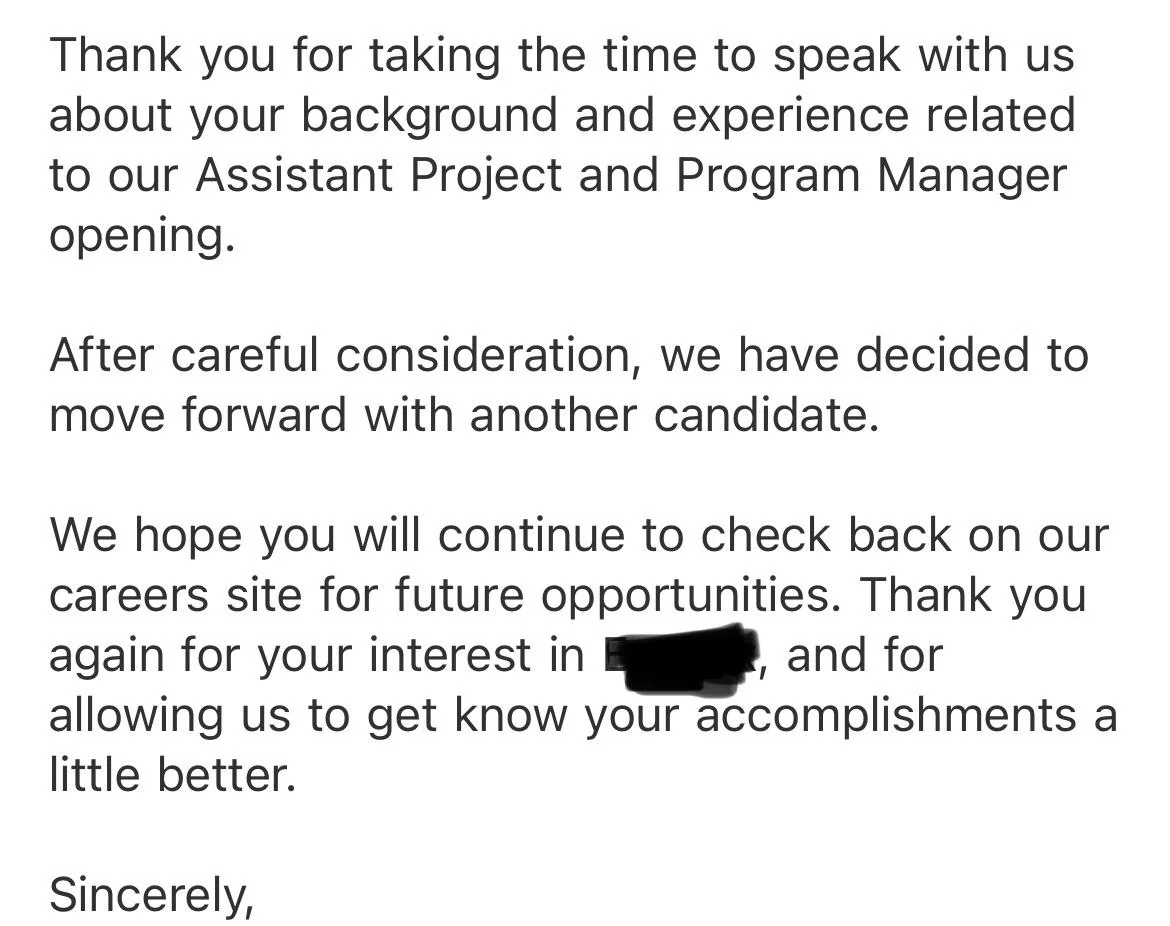
Should you ask for feedback?
Often, yes. You will not always get a reply, but a well-worded note can leave a positive impression and occasionally results in guidance you can use immediately.
Ask for feedback when:
- You interviewed (especially a later round).
- You had a pleasant back-and-forth with the recruiter or hiring manager.
- You genuinely want to improve, not debate the decision.
- You can keep the request short and professional.
Consider skipping it when:
- The rejection is clearly automated and you never spoke to a human.
- The process was extremely high volume (some entry-level programs) and feedback is unlikely.
- You feel too upset to write calmly (waiting a day is fine).
Timing and who to email
When to send
- Often works well: within 24 to 72 hours of the rejection.
- If you need breathing room: within 1 week is still reasonable.
- After a final round: sooner tends to help while details are fresh.
Who to send it to
- Recruiter: usually the safest choice. Recruiters can sometimes share broad themes, but some are not allowed to provide feedback due to company policy.
- Hiring manager: best when you directly interviewed with them and built rapport.
- Do not mass email the panel: pick one person (recruiter first, manager second).
If you are also sending a thank you note, you can combine it with a feedback request. If you want a dedicated thank you format, this guide can help: Thank you letter after job interview.
What to say and what to avoid
Make it easy to answer
- Keep it to 4 to 8 sentences.
- Make it clear you respect the decision.
- Ask for one or two specific areas to improve.
- Offer options: a quick reply by email is fine, no call required.
- Thank them for their time.
What to avoid
- Arguing the decision (even subtly).
- Asking for a full critique of your personality or interview performance.
- Pushing for insider details about other candidates.
- Guilt language like “I worked so hard” or “I really need this job.”
- Multiple follow-ups that start to feel like pressure.
Mindset shift: You are requesting coaching, not appealing a verdict.
Email samples
Use these as starting points. The examples below are written as complete, realistic emails, so you can borrow lines as-is.
1) Simple feedback request to a recruiter
Subject: Thank you and quick question
Hi Maya Patel,
Thank you for letting me know, and for coordinating the process for the Marketing Analyst role at Northwind Retail. While I am disappointed, I appreciated learning more about the role and the team.
If you are able to share, I would be grateful for one or two specific areas where my application or interview could have been stronger, so I can improve for future opportunities.
Thank you again,
Jordan Kim
2) After an interview with the hiring manager
Subject: Thank you for your time
Hi Elena Garcia,
Thank you again for speaking with me about the Customer Success Manager role at Pine Street Software. I enjoyed our conversation, especially about how your team is building a more proactive onboarding process.
If you have a moment, would you be willing to share any feedback on what I could strengthen for similar roles going forward? Even one suggestion would be very helpful.
Wishing you and the team continued success,
Jordan Kim
3) When you were a finalist (asking for actionable detail)
Subject: Feedback request for future improvement
Hi Maya,
Thank you for the update. I appreciated the chance to meet the team and learn more about Northwind Retail’s priorities for this role.
If you can share a bit more context, I would love to know what skill set or experience ultimately made the difference. For example, was it more about deeper SQL and dashboarding experience, more direct retail analytics experience, or something else?
Thanks for any guidance you can offer,
Jordan Kim
4) When you did not make it past the application stage
Subject: Quick feedback question
Hi Maya,
Thank you for reviewing my application for the Marketing Analyst role at Northwind Retail. If you are able to share, I would appreciate any brief feedback on what would make a candidate more competitive for this type of role at Northwind.
If feedback is not something you can provide, I completely understand. Thank you for your time,
Jordan Kim
5) When you want to stay on their radar
Subject: Thank you and staying in touch
Hi Maya,
Thank you for the update and for your time throughout the process. I remain very interested in Northwind Retail and would welcome the chance to be considered for future roles that fit my background.
If you can share one or two areas I could strengthen to be a better match next time, I would truly appreciate it.
Warmly,
Jordan Kim

6) If you suspect a missing requirement (without sounding defensive)
Subject: One question about role requirements
Hi Maya,
Thank you for the update. To help me target roles more accurately, may I ask whether the decision was mainly driven by a must-have requirement that I did not demonstrate, such as more hands-on experience with GA4 and paid media reporting?
If you are able to share any brief feedback, I would be grateful. Thanks again for your time,
Jordan Kim
Ask for feedback you can use
Vague questions often get vague answers. These prompts invite practical, low-risk responses.
Good questions (pick one)
- “What would you recommend I strengthen to be competitive for similar roles?”
- “Was there a skill gap I should focus on first?”
- “Was the deciding factor more about experience level, domain knowledge, or interview examples?”
- “Was my background a mismatch for the role scope (more junior or more senior than needed)?”
- “Is there anything I could do differently in how I present my experience on my resume?”
A tiny menu helps
Adding two to three options reduces the effort to reply. Example:
- “If you are able to share, was the gap primarily (1) technical depth, (2) industry experience, or (3) leadership and stakeholder work?”
If you want to tighten your resume alignment for the next application, this companion guide is handy: Tailor your resume to the job description.
Why they may not share feedback
It is common to get no response or a polite “we cannot provide feedback.” Often, this is due to company policy, legal risk concerns, or simply limited time, especially for high-volume roles.
In other words, a non-answer is not necessarily a signal that you did something wrong. Treat it as a closed loop, and keep your message trail tidy and professional.
If they cannot provide feedback
That is common, and it is not necessarily about you. Some companies have strict policies.
A graceful reply
Hi Maya,
Thank you for letting me know. I appreciate the time you and the team invested, and I hope our paths cross again in the future.
Best regards,
Jordan Kim
Then stop there. No second request, no pressure, no “just one thing.” A polite exit keeps the relationship intact.
If they share feedback
When someone takes time to help, a warm, professional thank you matters.
Thank you reply
Hi Maya,
Thank you for sharing this feedback. I appreciate the specific guidance, and I will focus on strengthening my campaign measurement examples and adding clearer outcomes to my resume. I enjoyed meeting the team and hope to have a chance to connect again down the road.
Best,
Jordan Kim
One clarifying question
If the feedback is broad, you can ask one follow-up question, not three. Example:
- “When you mention stronger stakeholder communication, would you recommend I include more measurable outcomes in my examples, or focus on cross-functional leadership?”
Reapplying and staying in touch
It is okay to express interest in future roles, but keep it light. Your goal is to stay remembered as professional, not to reopen the decision.
- Ask about future openings: One sentence is enough, as shown in Sample #5.
- When to reapply: If they gave you a specific timeline, follow it. If not, a general rule is to wait until something meaningfully changes, like a new opening, a new credential, or clearly stronger experience.
- Multi-channel caution: If you already emailed, avoid also sending LinkedIn messages to multiple interviewers about feedback. It can unintentionally feel like pressure.
Common feedback themes
Sometimes you will get a short line like “We went with someone with more experience.” Here is how to translate common phrases into a next step.
| What you might hear | What it usually means | What you can do |
|---|---|---|
| “More experience” | Depth in the exact type of work, or longer track record | Adjust target level, add relevant projects, and quantify similar work on your resume |
| “We needed a stronger technical fit” | Specific tools, stack, portfolio, or problem-solving examples | Fill gaps with focused practice, and revise interview stories using clearer technical detail |
| “Not the right scope” | You seemed overqualified or underqualified | Address scope directly in cover letter and interviews (why this level, why now) |
| “We chose someone with domain experience” | Industry knowledge mattered more than general skill | Use a targeted summary and case studies that show you can ramp quickly |
| “Another candidate was a slightly better match” | Close call, often minor differences | Ask what would have made the difference, then keep the relationship warm |
If you keep hearing “scope mismatch,” this guide can help you phrase it cleanly: Overqualified? How to address it in your cover letter.

Follow-up rules
- Rule 1: If you do not hear back, a common approach is to send one follow-up after 5 to 7 business days.
- Rule 2: If there is still no response, stop. Silence is an answer, and you have already shown professionalism.
Follow-up email sample
Subject: Quick follow-up
Hi Maya,
I know you are busy, so I wanted to follow up on my note below in case it got buried. If you are able to share any brief feedback, I would appreciate it. If not, I completely understand.
Thank you,
Jordan Kim
Checklist
- Did you thank them and acknowledge the decision?
- Is your request specific (1 to 2 areas)?
- Did you keep it short and calm?
- Did you avoid comparing yourself to other candidates?
- Is your subject line neutral and professional?
That is it. A small, well-mannered message can turn a closed door into a helpful nudge forward.
The short version
- Send your feedback request soon after the rejection. Within 24 to 72 hours often works well (within a week is still fine).
- Email one person: recruiter first, hiring manager second. Do not email the whole panel.
- Keep it short: thank them, accept the decision, ask for 1 to 2 actionable improvement areas.
- Use low-effort prompts: ask whether the deciding factor was skill depth, domain experience, role scope, or interview examples.
- Avoid arguing, sounding resentful, or asking for details about other candidates.
- If they cannot share feedback, reply politely once and move on.
- If you get feedback, thank them and (optionally) ask one clarifying question.
- If there is no reply, a common approach is one follow-up after 5 to 7 business days, then stop.
 Written by JotPublished
Jot is the pencil-carrying mouse drawn for Letter Samples. Newer guides go out under Jot's name. Jot isn't a lawyer, a recruiter or an HR department, so check anything formal against your employer's policy or local law. Who is Jot?