Filed under Resumes & Cover Letters
Hobbies and Interests on a Resume
Learn when hobbies and interests strengthen your resume, what types to include, where to place them, and when to leave them off to save space and avoid distractions.
A hobbies and interests section can be a tiny resume superpower or a space-waster. The difference is simple: it only belongs if it supports your candidacy by reinforcing skills, culture fit, or credibility in a way your experience section cannot.

When hobbies help your resume
Include hobbies and interests when they add job-relevant information or make your story easier to believe at a glance.
1) When you are early-career and need dimension
If you are a student, recent graduate, or changing fields, your resume may be light on professional experience. A carefully chosen interest can show momentum and genuine engagement.
- Helpful: “Open-source contributor (Python),” “Robotics club projects,” “Community theater stage manager.”
- Less helpful: “Watching movies,” “Hanging out with friends.”
2) When the hobby proves a job-relevant skill
The best interests do not just sound nice. They prove something.
- For analytical roles: chess clubs, competitive puzzles, data visualization projects, fantasy sports analytics (if described professionally).
- For people-facing roles: volunteer coaching, mentoring, community organizing.
- For creative roles: photography projects, writing portfolio work, music production (especially if you can link it elsewhere, like a portfolio site).
3) When it supports culture fit in a specific, safe way
Some teams value community, wellness, or learning. A light touch can help you feel like a real person and be memorable.
- Examples: “Distance running,” “Book club organizer,” “Language learner (Spanish).”
Culture fit should never be your main selling point, but it can be a nice extra when your qualifications already match.
4) When it adds credibility for the industry
In some fields, relevant interests can act like industry fluency.
- Outdoor retail: hiking, climbing, trail maintenance volunteering
- Games industry: game jams, modding communities
- Food and hospitality: culinary workshops, coffee tasting courses
Keep it professional and factual. No need to oversell it.
When to leave hobbies off
If you are debating, these are the situations where skipping is usually the smarter move.
Your resume is already tight
If you are struggling to fit impact-focused bullets, remove hobbies first. Hiring managers will almost always prefer measurable results over personal pursuits.
The interest is generic, polarizing, or too personal
Some details invite unconscious bias or distract from your qualifications.
- Too generic: travel, movies, “music,” “food”
- Potentially polarizing: political activism, religious identifiers, hot-button topics (unless directly relevant to the role and you are comfortable with it)
- Too personal: anything that reveals protected-class information you would rather not surface early
It is completely fair to keep your private life private.
You cannot explain how it connects
If someone asked, “How does that help you do this job,” would you have a clean, confident answer in one sentence? If not, trim it.
The hobby raises avoidable concerns
Even innocent hobbies can accidentally send the wrong signal depending on the role.
- High-risk sports might make some employers worry about injuries or time off.
- “Day trading” might read as risky or distracting for certain employers.
This does not mean you should hide who you are. It means your resume is a marketing document, not a biography.
A quick decision test
If you want a speedy way to decide, use this three-question filter. If you get two or more “yes” answers, hobbies can earn their spot.
- Relevance: Does it directly support a skill needed in the job description?
- Credibility: Is it specific enough to sound real and not like filler?
- Value per line: Is it more valuable than one more achievement bullet from your work or projects?
If you get mostly “no,” leave it off and use the space to tailor your resume instead. A helpful companion: Tailor Your Resume to the Job Description.
What to include (and how to phrase it)
The secret is specificity, with a professional tone. Think: what it is, the level, and any concrete output.
Better categories of interests
- Skill-building: “Korean language learner (intermediate),” “Public speaking (Toastmasters member).”
- Making things: “Woodworking,” “Sewing,” “Indie game development.”
- Community and leadership: “Volunteer coordinator for monthly food pantry distribution.”
- Endurance or discipline-based: “Marathon training,” “Classical piano (10 years).”
Wording that stays clean and employer-friendly
- Use nouns, not paragraphs: keep it scannable.
- Add a detail if it proves effort: level, frequency, role, output.
- Avoid jokes or sarcasm: humor is hard to read on paper.
Example formats:
- Interests: Trail running, community tutoring, home espresso
- Interests: Open-source contributions (GitHub), board game meetups, Spanish conversation group
- Interests: Volunteer soccer coach, nature photography, personal finance reading
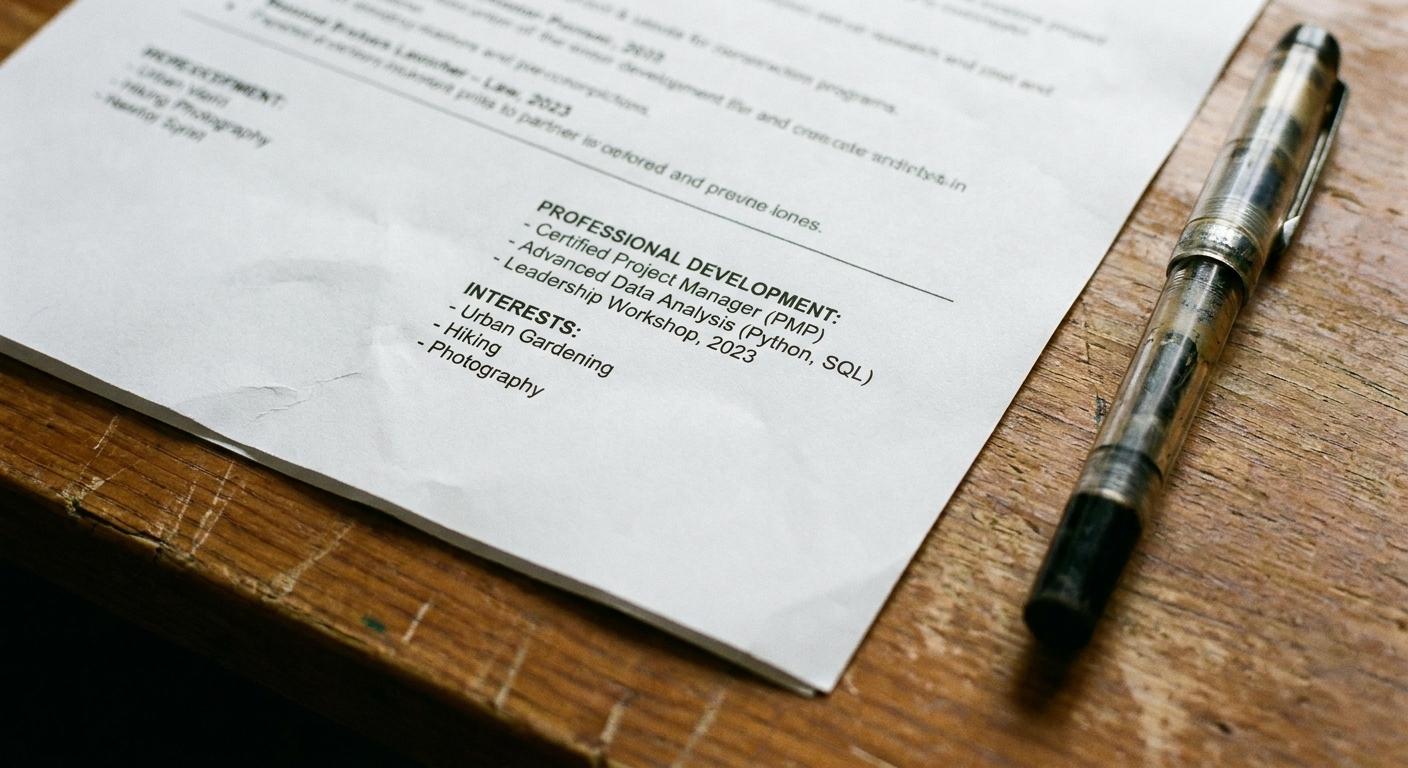
Where to put hobbies on a resume
Most of the time, interests go near the bottom. They are supporting actors, not the main cast.
Best placements
- Bottom section: After Experience, Education, Skills, and Projects.
- Sidebar (two-column resume): A short “Interests” list works well if it does not crowd out essentials.
How long it should be
- Ideal: 1 line or 3 to 5 bullets.
- Max: Enough to show personality without stealing space from achievements.
If you are aiming for ATS compatibility, keep the section label straightforward, like “Interests” or “Volunteer & Interests,” and stick to simple formatting. For more on keeping resumes machine-readable: ATS Resume Formatting Rules That Work.
Hobbies vs. projects vs. volunteering
Sometimes the issue is not whether to include personal pursuits, but where they belong.
Put it under “Projects” if it shows output
If you built something, shipped something, performed something, published something, or led something, it may deserve a stronger section than “Interests.”
- “Built a budgeting app used by 200+ users” fits under Projects.
- “Writes poetry” fits under Interests, unless published or performed regularly.
Put it under “Volunteer Experience” if it is responsibility-based
If you have duties, a schedule, or leadership responsibilities, treat it like experience.
- “Volunteer treasurer, neighborhood association” belongs in Volunteer Experience.
Keep “Interests” for light, true, supportive details
Interests are best when they add color and credibility, not when they are trying to do heavy lifting.
Examples: when it helps, and when it hurts
Example 1: Early-career marketing applicant
Include: “Community newsletter editor,” “Photography projects (portraits and events)”
Why: Shows writing, audience awareness, and creative eye.
Example 2: Senior accountant with a full page already
Leave off: “Travel, reading, yoga”
Why: Adds no proof and steals space from quantified accomplishments.
Example 3: Software engineer applying to a developer tools company
Include: “Open-source maintainer (package with 1,000+ weekly downloads)”
Why: Signals real-world collaboration and credibility.
Example 4: Customer support role
Include (optional): “Volunteer tutor,” “Community choir”
Why: Suggests patience, consistency, teamwork, and communication.
Common mistakes to avoid
- Overstuffing: If the section looks like a second resume, it is too big.
- Being vague: “Sports” is unclear. “Recreational volleyball league” is clearer.
- Using it to hide gaps: If you need to explain a gap, do it directly and professionally in your application materials. See: How to Explain an Employment Gap in Your Job Application Letter.
- Including anything untrue: Interviewers sometimes ask about interests to build rapport. Only list what you can speak about comfortably.
If you include hobbies, echo them in your cover letter carefully
A cover letter is a better place than a resume to add a quick, human detail, but only if it connects naturally to the work.
Example sentence: “Outside of work, I mentor first-year students in a local coding club, which has sharpened how I explain technical steps clearly and patiently.”
If you are keeping your cover letter tight, you might like: Short-Form Cover Letters.
The short version
- Only include hobbies/interests if they support the job: They should reinforce a skill, credibility, or culture fit, not fill space.
- Best times to include: early-career, career change, relevant industry passion, or when the hobby proves a useful skill (leadership, analysis, communication, creativity).
- Skip hobbies when: your resume is already full, the interest is generic, it could invite bias, or you cannot explain the connection in one sentence.
- Keep it small: 1 line or 3 to 5 bullets near the bottom of the resume.
- Be specific: “Volunteer soccer coach” beats “sports.” Add level, role, or output when it helps.
- Use the right section: If it has measurable output, consider “Projects” or “Volunteer Experience” instead of “Interests.”
- ATS-friendly formatting: Use a simple label like “Interests” and avoid complicated layouts.
 Written by JotPublished
Jot is the pencil-carrying mouse drawn for Letter Samples. Newer guides go out under Jot's name. Jot isn't a lawyer, a recruiter or an HR department, so check anything formal against your employer's policy or local law. Who is Jot?